Why XRP

Why a yield simulator takes a position on a single underlying asset — and the argument behind it.
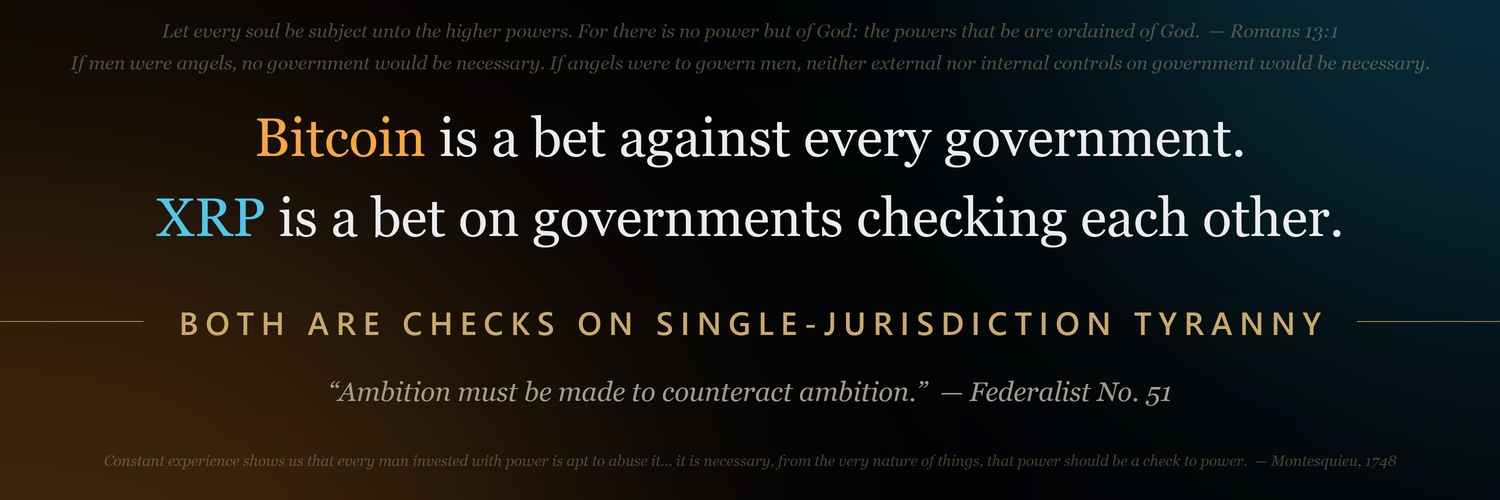
Bitcoin is a bet against every government. XRP is a bet on governments checking each other. Both are checks on single-jurisdiction tyranny. Framed by Romans 13:1, Madison's 'ambition must be made to counteract ambition' (Federalist No. 51), and Montesquieu's 'power should be a check to power' (1748).
The thesis in one frame — Scripture, Montesquieu, and Federalist No. 51 framing the two bets. Each quotation is argued in context in the sections below.

Yield presupposes an underlying asset

Every decision about where or how to earn yield is, underneath, a decision about which asset you hold while you earn on it. “Earn 8%” means nothing until you name the 8%-on-what. So the choice of underlying asset is the deepest assumption in this entire simulator — upstream of every rate, every strategy, every risk profile. YieldSim lets you vary the rates; this page argues the underlying asset they all sit on.

The case for that underlying asset being XRP is made in full in the thesis below, and distilled into the interactive argument beneath it.

The thesis in full

The conviction this app rests on — XRP as the asset worth holding, deterministic computation as the lab for testing it — is argued in full in the app creator's published thesis:

XRP: The Best Chance at Life-Changing Wealth in 2026
David Butler, 2026
DOI: 10.5281/zenodo.20241822
The intellectual framework YieldSim implements.

The argument

Six premises (P1–P6), then the conclusion. Click any node to reveal its supporting points; the tree drills deeper as the argument is built out.

P1 Stakes

Only institutional capital can justify crypto's projections, let alone its current valuations. Retail speculation is small — not because retail is small, but because most of retail does not invest beyond IRAs and index funds. The risk-on segment is niche and likely exhausted near crypto's current ~$2T range. Retail-only therefore means a thin, volatile risk-on market where the largest holders keep the edge even under regulation.

P1.A Retail risk-on demand is small in dollar terms and historically stable — so it sits near its practical ceiling.

Retail crypto participation is already high at small per-person allocations, so the marginal retail dollar that could lift crypto's ~$2–3T market cap is limited. Only institutional capital can justify the valuations — retail-only leaves a thin, volatile market where the largest holders keep the edge, even under regulation. Just how much of that deciding capital is still on the table is quantified in P6.B.

P1.A.1 Most households have little to put at risk: median retirement balances ~$45k (ages 35–44) and ~$185k (55–64); the bottom-half stock-owner holds a median of ~$12,600 (Fed SCF 2022). 59% of US adults can't cover a $1,000 emergency (Bankrate). More than half the world's working-age population has no retirement savings (World Bank).
P1.A.2 Even among investors, self-directed risk-taking is the minority: only ~21% of US families directly own individual stocks at all (SCF 2022, up from 15% in 2019), concentrated at the top of the wealth distribution; the mainstream holds diversified funds in IRAs and 401(k)s. Self-directed positions in speculative small- and mid-cap names — the risk posture comparable to buying crypto — are rarer still.
P2 Present State

Institutions are adopting DLT, but nearly all of it is permissioned ledgers plus tokenized real-world assets (stablecoins, CBDCs…etc.) — issued, freezeable assets. Demand for the neutral native token is negligible today: transactions and tokenization cost only the tiny network fee, so tokenization generates no native-token demand beyond that fee. Contrary to a common retail belief, tokenization does not create a supply shock. Anti-spam / fee demand and tokenization demand are the same negligible quantity as far as the native token is concerned.

P2.A Institutional DLT adoption is real but overwhelmingly permissioned ledgers + tokenized RWAs (stablecoins, CBDCs) — issued, freezeable assets.
P2.A.1 By value, institutional on-chain finance is almost entirely issued, freezeable instruments: ~$300B in stablecoins (≈99% US-dollar-denominated, per the ECB) and ~$26B in tokenized real-world assets (RWA.xyz, June 2026), led by tokenized US Treasuries (~$15B). The major bank rails are permissioned — JPMorgan Kinexys (~$5B/day), Citi Token Services, Canton, Partior — and every CBDC is sovereign-issued. By settlement volume, neutral, issuerless native crypto assets as a class carry under ~1% of that — institutional cross-border settlement in any non-issued native token totals on the order of tens of billions a year, dwarfed by the trillions on the permissioned rails above (JPMorgan's Kinexys alone clears ~$5B/day). The neutral-native rail exists, but it is still pre-institutional.
P2.B That activity creates no meaningful native-token demand: a transaction — including issuing or moving a tokenized asset — bids the native token only for the tiny fixed fee, so tokenization is not a supply shock (the common retail error).
P2.B.1 The mechanic: a transaction costs only a small, fixed network fee — a fraction of a cent — no matter how much value it carries (~0.00001 XRP on the XRPL, burned). A tokenized asset is an issued token — an IOU, or on the XRPL a Multi-Purpose Token — held in an account, not the native asset, and at most it locks a tiny fixed reserve. So issuing or moving trillions in tokenized value buys and locks no proportional amount of the native token; the only native demand it creates is the fee. Fee/anti-spam demand and tokenization demand are therefore the same near-zero quantity.
P3 The Demand

Either demand migrates from issued assets toward a neutral-native use case that requires neutral native-token liquidity on a public chain, or the valuations are unjustified and crypto stays a casino. The bet is that this migration does occur eventually, pushed by global de-dollarization — currency weaponization, inflation — and a crisis of fragmented liquidity; this premise argues those conditions are already underway.

P3.A The driver already exists — de-dollarization, via currency weaponization, the Triffin Dilemma, and a crisis of fragmented liquidity — and the demand it creates is necessarily for a neutral, issuerless asset, because freezeable issued assets and permissioned ledgers cannot serve cross-jurisdiction settlement.

Two asides. First, the position is not that the dollar dies: it stays dominant and remains the settlement rail for the US and anyone who trusts it — the claim is only that diversification away from it is structural and already underway, occurring at the margin. Second, the bet's main risk is the null case: that the void is filled instead by gold, jurisdictional CBDC rails, and a stablecoin patchwork, so neutral-native demand never arrives at scale. This premise argues the three pressures below are underway; it does not claim the destination is reached yet. The strongest form of that null case is a multilateral central-bank bridge such as Project mBridge — the 'Multilateral Rail' — which P4.B.4.5 shows is only second-best.

P3.A.1 De-dollarization is measurably occurring. Its structural cause is the Triffin Dilemma: the issuer of the world's reserve currency must run persistent deficits to supply global liquidity, steadily eroding confidence in it, so no single national currency can hold the neutral-reserve role indefinitely. The shift shows in the data: central banks bought over 1,000 tonnes of gold a year in 2022–2024 and ~850t in 2025 (still ~twice the 2010–21 average), and by end-2025 gold overtook US Treasuries in their reserves for the first time since 1996 (gold ~27% vs Treasuries ~22%); the dollar's reserve share has slid from ~71% in 1999 to ~57% (IMF COFER, Q4 2025). Behind it sits an unsustainable US fiscal path — ~$39T debt, ~$1T/yr net interest heading toward ~$2.1T by 2036, with no turnaround in sight. The occurrence is broadly agreed; only its endpoint is debated.
P3.A.2 Currency weaponization is demonstrated, and it is why the asset must be issuerless. After February 2022, ~$300B of Russia's reserves were frozen and its banks cut from SWIFT — showing every non-aligned state that dollar and euro rails are, ultimately, foreign-policy instruments. The same freeze switch works on issued digital money: Circle blacklisted USDC addresses within hours of the 2022 Tornado Cash sanctions; Tether has frozen $3B+ since 2017, including ~$344M in USDT tied to Iran's central bank in April 2026. So a freezeable issued asset — and equally a permissioned ledger, which is just a controlled club — cannot serve as neutral settlement between parties who do not trust each other's regulators.
P3.A.3 Fragmented liquidity is a mechanical consequence, not a forecast. Among ~180 national currencies, settling every pair directly would need deep liquidity across ~16,000 possible pairs; a single common denominator collapses that to ~180. That is the problem the 1944 Bretton Woods system solved by routing the world through the dollar. Erode that one denominator without a replacement and the pairwise-liquidity problem returns — so de-dollarization, by itself, manufactures demand for a neutral bridge, whose required properties are specified in P4.
P4 The Supply

Meeting the P3 demand requires two properties: (a) democratic, NATO-level neutral governance (the UNL); and (b) a protocol-native neutral DEX that routes through an issuerless native asset, preferring that asset when it is the most liquid path. The DEX-routing in (b) is the conversion mechanism: it channels P3's settlement demand into committed-depth demand for the native token. Demand is inherited from P3 and is not re-argued here — this premise only specifies what a ledger must have to capture it.

P4.A Neutral governance: the supply must be governed by a jurisdiction-diverse council no single sovereign can capture, yet one that can still act and evolve — the governed-neutral middle of the decentralization spectrum.
P4.A.1 Both extremes of the decentralization spectrum fail, so neutrality has to live in a governed middle — decentralized enough that no one party can capture it, governed enough that it can evolve.
P4.A.1.1 Full centralization (a single sovereign server — the central-bank model) is capable and accountable, but it is a single point of capture that can be weaponized, and it offers no neutrality to parties who distrust the controller.
P4.A.1.2 Maximal decentralization fails the opposite way. Proof-of-work is ungovernable by design — it cannot adapt or repair itself — and re-centralizes anyway at physical chokepoints (cheap power, ASIC supply, fiat on-ramps). Proof-of-stake relabels the concentration as staking pools and hands rule-making to an unaccountable insider circle. One pole is captured by a party, the other by whoever controls the hardware or the stake.
P4.A.2 A jurisdiction-diverse council that can act only by broad supermajority is Madison's Federalist design applied to money. Federalist No. 51: structure power so no faction can capture the system, yet it can still act ('oblige it to control itself'). No. 10: a large, diverse body dilutes any single faction. The monetary form is a constitutional republic of money — not a sovereign, not a mob — where changing the rules sits closer to a constitutional amendment than a bare majority. Compliant enough for institutions, neutral enough for sovereigns who distrust each other: that tension is the design, not a flaw.
P4.A.3 Consensus must run on a council of independently chosen validators (a UNL): each operator picks its own list, anyone may run one, no party controls inclusion, and lists must overlap heavily to stay one network. Acting — closing each ledger and, above all, changing the rules — takes a broad supermajority (~80%), and a rule change must hold for weeks on-ledger. The vote counts by identity and reputation — one trusted operator, one vote — not by asset or hashpower held; every vote is cryptographically signed and public, so ballot-stuffing is impossible and collusion is visible. This is the shape every body that governs modern finance already takes (BIS, IMF, FATF) — a deliberate council of major stakeholders, diverse enough to resist capture, coordinated enough to decide — which is why the money-holding constituency prefers it.
P4.A.3.1 Proof-of-work and proof-of-stake both auction the right to propose a block by a wealth-weighted lottery — tickets bought with electricity (PoW) or staked tokens (PoS), so the wealthiest win the most turns — then settle rule-changes off-chain through an insider franchise no outsider can audit. A reputational, one-operator-one-vote council with public, on-ledger rule-changes is the alternative an institution can underwrite.
P4.A.4 The only governance attack that matters reduces to a fork — and a fork is decided by the economic majority, not by node count. A hostile supermajority cannot seize a balance: the neutral asset has no freeze and no mint, and moving a coin needs its key. The worst it can force is a competing chain — and any chain can fork. But a fork clones every balance onto both chains, and which copy the market treats as the real asset is settled by the economic majority — the exchanges, custodians, liquidity, and capital — not by how many nodes installed the new software.
P4.A.4.1 SegWit2x is the proof. In 2017 a supermajority of Bitcoin mining power — companies representing over 80% of the hashrate, signaling near 90% — agreed to force a block-size hard fork. It was abandoned days before activation because the economic majority (users, exchanges, custodians, and the capital that prices the asset) would not accept it as Bitcoin. Hashpower and node count backed the change; the economic majority overruled them. Which chain is real is decided by the holders of the money and the venues that price it, not by the count of nodes or miners.
P4.A.4.2 That property is a liability for 'the people's money' and the decisive feature for institutional settlement. Bitcoin and Ethereum are sold to a base whose whole value proposition is censorship-resistance, so a fork adding the compliance or censorship institutions require would be rejected by that base and abandoned by the economic majority — those chains cannot structurally become governed settlement rails. A neutral settlement layer's constituency IS the economic majority — the institutions and states that hold the money and wield enforcement — for whom a governed compliance capability is the value proposition, not a betrayal. So governance accrues to exactly the parties it must serve, and the only coalition large enough to move the chain is the neutrality-wanting set that will not vote to impoverish itself. The mutual antagonism is the safeguard: Madisonian discipline made financial.
P4.A.5 Governed consensus changes its rules by a deliberate, signed, on-ledger supermajority vote — the one move ungoverned chains cannot make. Bitcoin has no body to decide a rule change: it is fought between two uncoordinated layers — the miners who propose blocks and the economic nodes that validate them — and settled only by a standoff. Even a soft fork, which forces no one off the chain, can deadlock. SegWit — the backward-compatible soft-fork half of the same 2017 fight — was backed by most developers yet stalled for over a year against miner resistance, until a user-activated soft-fork threat (economic nodes vowing to orphan non-signaling blocks) forced it through. BIP-110 is the same dysfunction live in 2026: a modest, time-limited soft fork to curb data bloat, splitting the community over whether 55% or the traditional 95% threshold should activate it, with Adam Back warning of a chain split. A network with no authorized way to decide cannot ship a change cleanly even when it serves its own survival; it can only hold a standoff and hope one side blinks. A governed council makes that same decision a vote, not a brawl — compliance primitives, quantum-resistant cryptography, and the like pass by supermajority without the schism. Coordinated upgrade is a property of governed, trust-based consensus, not of hyper-decentralization.
P4.B A protocol-native, pooled, issuerless-routing DEX — the venue that turns the neutral asset from a store of value into the inventory the system clears through, and the mechanism that converts P3's settlement demand into committed-depth demand for the native asset.
P4.B.1 A DEX is the demand engine because a native token, on its own, is only a store of value held on belief; it becomes a bridge only when it turns into the inventory unlike assets trade through — and assets trade on an exchange. What lifts the asset is not demand-to-pay — a network fee is trivial per transaction — but demand to hold it in size: the system cannot clear a swap between unlike currencies without deep bridge-asset inventory sitting in the route. Thin depth in the bridge means the swap moves the price against itself, so clearing at scale without slippage is what forces the inventory to be held — and that held inventory is the asset earning its value from use rather than belief.
P4.B.2 A settlement DEX must satisfy three conditions at once, and most architectures fail at least one.
P4.B.2.1 The exchange must be native to the ledger's consensus, not a contract or app bolted on top — because a bolted-on exchange runs on a virtual machine that knows nothing of trading, with routing chosen off-chain by aggregators, which puts parties back between you and the trade. You then have to trust the contract to carry no exploitable bug (the DAO, Euler, and Cetus each lost hundreds of millions) and trust the venue's operators — a front-end that geofences and blocks addresses, an off-chain router that orders your fill, a governance that can change the rules. A sovereign that cannot freeze the coin can still lean on any of them, so neutrality leaks at the exchange even when the asset itself cannot be frozen.
P4.B.2.2 Liquidity must be pooled and shareable — depth any pair can draw on, with an order book and automated pools unified by one routing and auto-bridging engine, not split into private two-party channels or locked to a single pairing currency. With thousands of asset pairs none can hold deep direct liquidity, so routing swaps through shared bridge-asset depth is the only way to clear at scale without punishing slippage.
P4.B.2.3 The route must be able to run through an issuerless native asset — but routing is decided by best execution, not by decree: the engine takes whichever path is deepest, using the native asset when it is the most liquid bridge for a pair and a stablecoin when that is, pair by pair. So the requirement is twofold. The protocol must let the issuerless native asset compete for the route, so its share grows as its depth grows; and it must let neutral, identity-gated pools be constituted on the same ledger (permissioned domains and a permissioned order book), so that where neutrality is the requirement, deep neutral liquidity is guaranteed rather than left to whichever issued token happens to be deepest.
P4.B.3 A pooled venue must protect its liquidity providers, or the depth is not sustainable. Automated market-making has a standing leak: a study of the largest such venue found about half its providers finishing behind simple holding once arbitrageurs took their cut (loss-versus-rebalancing). A venue that needs deep, durable inventory has to attack that leak directly — for instance by auctioning the arbitrage trading-slot back to providers, so the profit that would bleed out of an ordinary pool is returned to the providers who would otherwise lose it. It does not erase the loss; it turns much of it from leakage into income, which is what makes committing depth a sustainable trade instead of a losing one.
P4.B.4 Most architecture types fail at least one condition. The named survivors and the winner are picked in P5, which harkens back here; this establishes only that the three conditions are stringent.
P4.B.4.1 Smart-contract chains (Ethereum, Solana) fail the native condition: the exchange is a third-party contract on a virtual machine that knows nothing of trading, routed off-chain by aggregators — so you trust the contract not to carry an exploitable bug and trust its front-end, router, and governance, any of which a sovereign can lean on. Their issuerless native asset (wrapped Ether is widely used and routes well) can bridge, but the protocol gives it no way to guarantee a neutral route or to constitute identity-gated neutral pools — so where neutrality is required, nothing in the architecture guarantees it is available.
P4.B.4.2 Bitcoin fails the native and pooled conditions outright: its scripting cannot express an order book or a liquidity pool, so the base layer has no exchange. Lightning is a payment mesh of private, pre-funded two-party channels, not an exchange, and the design does not scale into a pooled neutral venue: routing value any distance requires a path of channels each funded large enough to carry it, which forces liquidity to concentrate in a few well-capitalized hubs — the opposite of shareable pooled depth. 'Lightning inherits Bitcoin's security' inherits settlement security, not decentralized liquidity; the liquidity lives in those private channels, not on the chain.
P4.B.4.3 Bitcoin's more capable venues each surrender the property they were meant to protect. Liquid is an ~87-member federation that issues the traded asset and controls the peg — the consortium model wearing a Bitcoin label. Channel factories and Ark ease channel lockup only by adding a provider that holds everyone's liquidity. A zero-knowledge rollup (Citrea, 2026) can host a fuller exchange, but bitcoin reaches it across a federated bridge that turns it into a pegged claim. The dilemma is structural: keep issuerless bitcoin with no pool and no venue, or gain a capable venue by pegging bitcoin into a freezeable claim — never both, absent a protocol change the BIP-110 fight shows Bitcoin struggles to make.
P4.B.4.4 Two categories don't even reach the test. Consortium ledgers and bank rails (Canton, Kinexys, Partior) run exchanges but offer no issuerless asset — a tokenized deposit is liquidity only where its issuer honors it. Messaging and interoperability layers (CCIP, atomic-swap protocols, SWIFT) aren't exchanges at all — they move assets between venues and leave open which venue actually clears.
P4.B.4.5 The strongest form of the null case (P3.A) is a multilateral central-bank bridge — Project mBridge, the 'Multilateral Rail' — which fills the de-dollarization void but is captured on the axis that decides it. It is not single-operator: each member central bank runs a validating node and rule-changes need consensus, so on governance it resembles the UNL. The decisive, unconditional difference is asset-control — an XRPL validator orders transactions but cannot freeze, seize, or mint the native asset, whereas mBridge's validators ARE the issuers of the settled money and each can freeze its own CBDC at will: a list whose members cannot touch your value versus a club whose members issue and can freeze it. Liquidity is the trap it cannot escape (the P3.A.3 pincer applied): with no neutral bridge asset, liquidity either fragments across every pair or collapses onto one dominant currency, and on mBridge that hub is the e-CNY (~95% of volume) — a sovereign's freezeable liability — so the only escape from fragmentation IS capture. The atomic-settlement defense answers the wrong risk: payment-versus-payment removes counterparty/settlement risk, not the censorship and freeze risk the permissioned venue and freezeable hub impose. Net: neutral at neither the asset nor the venue, it serves states that already trust the club and offers nothing to the non-trusting counterparties the neutral role exists to serve. (The three classic functions restate the same verdict: ledger permissioned, asset freezeable, venue gated.)
P5 Selection

Of all candidates, XRP best fits P4 — judged by technology fit, adoption trajectory, and the track record of its bootstrapper (Ripple). Not by current volume: some institutional activity already exists, but the bulk of institutional allocation is still ahead, behind a regulatory moat — the timing and mispricing are argued in P6.

P5.A Measured against the P4 spec, XRP is the only asset that passes every condition — the winner named at last.

P4 set two requirements — governed-neutral consensus (P4.A) and a protocol-native, pooled, issuerless-routing exchange (P4.B) — and showed why each architecture type fails one. Applying that scorecard names the winner; the reasoning lives in P4, so it is not re-argued here.

P5.A.1 The rivals fall on conditions P4 already established. Bitcoin: ungovernable proof-of-work (P4.A.1) with no native pooled exchange (P4.B.4.2). Ethereum and Solana: insider-governed proof-of-stake (P4.A.1) on a bolted-on, coercible third-party exchange (P4.B.4.1). Permissioned and consortium ledgers (Canton, Hedera): a controlled club (P4.A.1) with no issuerless asset (P4.B.4.4). Multilateral CBDC bridges (mBridge — the 'Multilateral Rail'): governed-neutral in form but a controlled club in fact (P4.A.1), with no issuerless asset and a coercible permissioned venue, so they fail neutrality at all three functions of money (P4.B.4.5). SWIFT and the messaging/interoperability layers: not neutral settlement, and not an exchange at all. Each fails at least one of the two requirements; XRP passes both.
P5.A.2 Only one rival passes the architecture: Stellar, forked from the same codebase, with a protocol-native order book, a native AMM (since 2021), and issuerless XLM routing. The three exchange conditions do not separate the twins; three smaller things do. XRPL's pools protect their liquidity providers through the auction mechanism (P4.B.3) where Stellar's plain pools do not. Stellar's foundation markets the network primarily as a peer-to-peer remittance and payments rail, not the explicit neutral institutional bridge-asset role Ripple has pursued for XRP — and states to this day. And XRPL has a capitalized commercial actor driving the asset into regulated finance, where Stellar has a nonprofit foundation (P5.C). None is a knockout — Stellar is the same forward bet with less behind it — and a winner-take-most race rewards the better-positioned leader.
P5.B The adoption trajectory bends toward the XRPL — judged by where post-regulation capital is heading, not by today's volume or price.
P5.B.1 The bet is not on current volume against Solana or Ethereum; it is on where institutional capital goes once it is cleared to allocate in a multipolar world. Positioning leads, deployment lags — so the signal to read is the slope (venue selection, corridor growth, regulated on-ramps), not the snapshot. An asset whose institutional allocation is still mostly ahead of it is exactly what an early, unpriced position looks like (P6).
P5.B.2 The slope is visible and dated. The institutional stack shipped to mainnet in early 2026 (Permissioned Domains, Token Escrow, a Permissioned DEX). SBI Remit (Japan, a default-UNL jurisdiction) has cleared over $15B in cross-border transfers on the XRP bridge since 2021 across 26 partner banks, ~60% cheaper than SWIFT — here the bridge asset is native XRP. Bitso (Mexico, which runs a default-UNL validator) issued a regulated peso stablecoin (MXNB) and wired it into the Permissioned DEX alongside RLUSD for the US-Mexico corridor (2026). JPMorgan's Kinexys, Mastercard, Ondo, and Ripple settled a cross-bank tokenized-Treasury redemption on the XRPL in under five seconds (May 2026). Ripple Prime joined the DTCC's NSCC (March 2026); seven spot-XRP ETFs trade (~$1B AUM as of July 2026, marked down with the June drawdown). Caveat: most of this proves the VENUE — institutions settling on the XRPL in RLUSD and stablecoins — not yet native-XRP bridge demand; SBI is the exception, and it runs through Ripple's product rather than the open DEX.
P5.B.3 What converts the bet from projection to fact is a short, named list of signals — and none has fully arrived, which is exactly why the position is still early (P6): a second jurisdiction running the Japan/SBI native-XRP corridor playbook; the first treasury or interbank corridor settling in native XRP on the public DEX (not a stablecoin, not Ripple's rail); and — the neutrality signal from P4.A — the first non-aligned (Chinese or Russian) validator even broadcasting toward the UNL, the day 'neutral East-West bridge' stops being a projection. Their current absence is the bet's forward status, not a refutation of it.
P5.C The bootstrapper's track record: a capitalized commercial actor (Ripple) whose conduct, not its slogans, keeps confirming it is building the rails and then stepping back.
P5.C.1 Ripple is the starter motor. It cannot mint, freeze, or switch off XRP — the asset is native to a ledger Ripple neither owns nor controls — so its only play is to build the regulated rails that make a neutral asset it holds usable at institutional scale, then disengage as the network carries its own load (the Bendix drive: ODL, Ripple Payments, and RLUSD crank the flywheel, then the starter drops out). It captures both layers — the dollar layer through RLUSD, the neutral layer through XRP — and holds XRP as its north star. A promoter keeps you believing a story; a bootstrapper makes the asset useful and gets out of the way.
P5.C.2 The decentralization is shown by conduct, not claim. In 2017 Ripple ran five of twenty-five validators — an outright majority — and published a formal program to remove one of its own for every two reputable third parties added; by 2023 it ran a single validator of thirty-four, with curation handed to the independent XRPL Foundation. An entity seeking control does not voluntarily cut itself from a five-of-25 majority to one vote of 34. (This is the governed-neutral set P4.A described, built deliberately to widen.)
P5.C.3 The rails are built, not only promised — roughly $3B of strategic acquisitions, each a piece of plumbing institutions require before they can allocate: Metaco (bank-grade custody, ~$250M, used by Citi, BNP Paribas, Société Générale), Standard Custody (the New York trust charter behind the Fed master-account filing), Hidden Road relaunched as Ripple Prime (a prime broker clearing ~$3T/yr for 300+ clients, $1.25B), Rail (cross-border stablecoin payments), and GTreasury (treasury software in 1,000+ enterprises). Add RLUSD (reserves custodied by BNY Mellon), an OCC-conditional national trust-bank charter (Dec 2025), and adjudicated legal clarity — Ripple won the SEC case, a test no rival sponsor has had to pass. No other digital-asset sponsor has assembled this.
P5.C.4 The motive is discernible on the balance sheet — Ripple holds a large XRP position and gains as the asset re-rates. And because it can EARN on that position as the on-chain economy matures (lending, AMM yield — the YieldSim thesis) rather than only sell it, the usual bear inevitabilities — escrow-unlock sell pressure, and a sponsor's motive fading once the network is built — are not inevitable. A bootstrapper's incentive is alignment, not exit.
P5.C.5 The deeper, non-fading motive is the middleware franchise. Most institutions will never be blockchain experts; they reach the neutral ledger through a company that builds the ISO 20022-to-XRPL translation, custody, and compliance layer — and the same trust geography that creates the neutral-bridge demand forbids one such company serving all of it: a non-aligned state that won't route through Western plumbing won't route through a US-domiciled, OFAC-subject middleware either, so each jurisdiction must build its own (a China-domiciled connector, a repurposed SWIFT/mBridge gateway), all settling across the one rail none of them issues. Ripple's enduring incentive is therefore to win and hold the position of XRPL-middleware for as much of the West as will trust it — an annuity that pays as long as institutions settle on the XRPL without operating it themselves, and that survives the distribution of its XRP, defeating the 'sponsor's motive fades once built' bear line of P5.C.4. It reinforces neutrality rather than threatening it (the chokepoint answer): winning the middleware layer is not capturing the bridge, which sits one layer below on a permissionless ledger every rival middleware plugs into and any party can reach directly. Ripple's toll is therefore optional — a fee on its own on-ramp, never a gate on the bridge: most actors opt into some middleware (their own or another's) that translates their banks' messages into XRPL transactions on the same public DEX, where auto-bridging routes through XRP, but anyone can skip every middleware and transact on the DEX directly. That standing direct path keeps the toll optional — Ripple monetizes the XRPL's use without being able to gate or weaponize access to it. Every reason to make the XRPL the universal substrate; no ability to make itself a mandatory chokepoint on it.
P6 The Opportunity

Given XRP captures the role (P5), this premise is the whole asymmetric bet: a large, convex upside against a bounded floor, on an asset whose price has not yet reflected it. The three legs — how large the upside is, why it is still unpriced, and why the downside is bounded — are argued below.

P6.A The upside is large and convex — a return multiple that conventional bets cannot deliver from a small base.
P6.A.1 The neutral cross-jurisdiction settlement marketshare XRP captures, scaled by the de-dollarization flows of P3, sets the repricing — and how large the multiple is. That captured share is the speculative variable; it decides the degree the bet wins, not its direction.
P6.A.2 Value it the way commodities are valued, or the target sounds absurd. XRP has no earnings and never will, so its price is set at the margin a holder will part with a unit — like a commodity, not by the discounted cash flows that '$50 XRP is near Microsoft' wrongly assumes. The right peer for that method is gold (~$33T): a commodity priced by what holders will accept, serving a neutral monetary function. This is a parallel of valuation method, NOT a peg — XRP's price is not tied to gold's, gold's price says nothing about XRP's level, and the comparison stops there, because the world has never had a highly liquid version of such a neutral commodity (gold cannot settle in seconds; XRP can). What actually sets XRP's level is not Total Value Locked (a retail-DeFi yardstick) but Total Value Committed: the XRP that institutions, market-makers, AMMs, and treasuries must hold available in pools, order books, and the auto-bridge for thousands of combinatorially-growing pairs to clear without slippage. TVC leads; the store-of-value premium follows.
P6.A.3 From a small base the magnitude is what conventional bets cannot match. A hard-capped supply meeting winner-take-most bridge demand is a supply shock; the central case is 20–40x — a ~$50k median pile becoming $1–2M. NVIDIA cannot do that from here (above $5T with five years of AI capex already priced in, its upside is single-digit), and an index fund at 15% for a decade reaches ~$202k. The multiple is available now only because the position is still early (P6.B).
P6.B The price has not yet reflected the upside — today it reflects current volume and the retail demand of P1, not the institutional allocation still ahead.
P6.B.1 The capital that decides hasn't allocated. All of crypto is ~$2.3T — about 2% of the world's ~$100T in broad money (M2) and under 2% of the ~$147T in professionally managed assets (BCG, 2025). Institutional allocation is smaller still: total crypto-ETP AUM is ~$200B, roughly 0.1% of managed assets, and most crypto value is still the retail risk-on bid of P1, not institutions. So price today reflects the small money that has already chosen; the broad money that will pick a neutral settlement standard is almost entirely still on the table — we are early.
P6.B.2 And converting that upside to price takes less inflow than the headline implies. Market cap is circulating supply times the last marginal trade — realized capitalization, valuing each unit at the price it last moved, runs well below it — so a high cap does not require that much money deployed; marginal demand against a thin float bids the price up and reprices the rest. Meanwhile the float that sets the price keeps shrinking: spot-ETF custody, treasury vehicles deploying into AMM yield, market-maker inventory, OTC desk reserves, and auto-bridge depth all pull supply off public order books — and an AMM position that yields from network use turns holding into positive carry, removing the reason to sell. Thin float plus shrinking float is the mechanism that reprices the asset.
P6.C The downside is bounded — the floor rests on committed-liquidity value, not belief.
P6.C.1 The floor is the committed XRP depth the system needs to clear cross-currency settlement — demand to hold, not belief — valued as a neutral-function commodity (the gold-category method of P6.A.2, not a peg to gold), not as an equity multiple. Capture even a minority of the neutral-bridge role and that floor sits far above a belief-only price. The TVC shortfall a skeptic points to today is the setup, not the rebuttal: if the depth were already there, the upside would already be priced.
P6.C.2 There is also a concrete reference point. Bitcoin's all-time-high market cap — roughly $2.5T — was set by the retail-dominated flow permitted before institutions could allocate at scale (P1); matching that cap puts XRP near $38 at today's supply. For an asset positioned to take a deeper-than-retail institutional bid, Bitcoin's retail-built peak reads as a floor, not a ceiling — and it sits well below the commodity-valuation ceiling of P6.A.2 if the bridge role materializes.
P6.C.3 Nuance: anything can in principle go to zero, but a bet is judged on probability, not certainty — and the degree of likelihood is what sets how much capital to risk, not whether the floor exists.
Conclusion: XRP is the best available asymmetric bet.